

(K-1) Fiancé Green Card

How Much Money do I Need to Sponsor My Fiancé to the USA?

How Much Money do I Need to Sponsor My Fiancé to the USA?

“How much money do I need to sponsor my fiancé to the USA?” is a popular question. The easiest way to understand the answer is to know what is required for each stage of the fiancé visa process. The fiancé visa process can broken down into three stages.

Stage 1- Proving the Relationship

In the first stage of the case, you have to prove to the U.S. government that you are in a bona fide relationship with your fiancé. You must also prove that you plan to marry your fiancé within 90 days of his/her arrival to the U.S. For this stage of the case, you must file an I-129F petition for your fiancé, with USCIS. You do not need to prove your income just yet. If you do not make the minimum income, you have months to get your finances in order.

Total Cost for Stage 1 of the Fiancé Visa Process

  • I-129F Petition Filing Fee = $675
  • Attorney’s fees = $1,500

It will take approximately 8-12 months for the government to make a decision on the petition. If USCIS approves your petition, it will be valid for four months. USCIS then sends your approved petition to the National Visa Center (NVC) for a case number. After the NVC assigns a case number, it routes the file to a U.S consulate or embassy for your fiancés interview. No fees are paid to the NVC. So far, you should be getting an understanding of “how much money do I need to sponsor my fiancé to the USA?”

Stage 2- Applying for the K-1 Fiancé Visa

In the second stage of the fiancé visa process, your fiancé is ready to apply for a K-1 fiancé visa. During this stage you may be required to prove that you can financially support your fiancé. If your fiancé is financially secure he or she may be able to use his or her income or assets without needing yours. The immigration officer may ask for form I-134 Declaration of Financial Support at the interview. A copy of your most recent tax return and current paystubs should be sufficient evidence that you can support your fiancé. You need to keep your fiancé at 100% above the federal poverty guidelines, during this stage. You can rely of form I-864P listed below for the minimum income requirements in 2024.

How-much-money-do-I-need-to-sponsor-my-fiance-to-the-USA

Total Cost for Stage 2 of the Fiancé Visa Process

  • DS-160 visa application = $265
  • Medical Examination = $100 (varies by country)
  • Police Certificate = $20 (varies by country)
  • Attorney’s fees = $1,500

This stage of the process normally takes between 1-2 months depending on the availability of visa appointments.

Stage 3- Marriage and Green Card Application

After your fiancé arrives in the USA and you are married, it is time to apply for permanent residence. During this stage of the case, your foreign-born spouse must file form I-485. He/she may also simultaneously file an application for employment authorization. There is usually a decision on the employment application months before there is a decision on the adjustment of status application. If the employment authorization application is approved, your spouse may be able to get a job and help pay some of the immigration fees. He or she may also be able to contribute financially to the household. You are required to file form I-864 at this stage and prove that you have sufficient income to keep your spouse above 125% of the federal poverty guidelines listed in form I-864P above.

Total cost for stage 3 of the fiancé visa process without an interview

  • I-485 Application to Adjust Status = $1,440
  • I-765 Application for Employment Authorization = $260
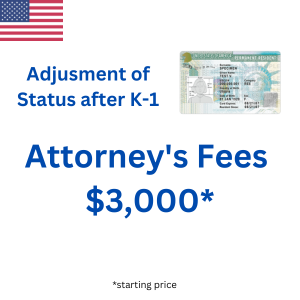
  • Attorney’s fees = $3,000

The processing time for the employment authorization application is approximately 6 months while a decision on the adjustment of status application may take approximately 12-18 months.

What are the Benefits of Hiring an Attorney?

An experienced immigration attorney can save you time and prevent costly mistakes. The attorney may even save your relationship by shortening processing time.

Anyone can print immigration forms from the internet and mail it in, however it is not the US government’s job to check if you have done it right. When you file your application, the government simply takes you filing fee and mails you a receipt notice. No one checks if you have made a mistake at the time of filing. It will be months before an immigration officer looks at your application and makes a decision. If you have not proved your case, you will receive a denial notice. Sometimes the officer may issue a Request for Evidence (RFE) and give you a chance to correct errors. However, they do not guarantee that you will receive an RFE.

Hiring a qualified immigration attorney early in the process can set up you application for success. Going it alone during the immigration process causes unnecessary anxiety, especially if you have never filed for a fiancé before. It doesn’t have to be this way.

Can You Marry Someone Else on a Fiancé Visa?

Can You Marry Someone Else on a Fiance Visa? Overview

“Can you marry someone else on a fiancé visa?” is not the question that you should be thinking about at the time of your engagement. However, life is unpredictable, and situations can change. If you find yourself  considering marrying someone other than your fiancé, it’s important to understand the implications of your visa status and explore your options.

Understanding the Purpose of the Fiancé Visa

The K-1 fiancé visa is designed specifically for foreign nationals who intend to marry a U.S. citizen within 90 days of arriving in the United States. The visa’s purpose is clear: to allow entry into the U.S. for the purpose of marrying the person who petitioned for you. If, after arriving in the U.S., you realize that you don’t want to marry your fiancé, you still have some options.

Can I marry someone else on a fiancé visa?

What Happens If I Don’t Marry My Fiancé?

Usually, the K-1 fiancé visa is valid for six months. However, after you enter the U.S., you can stay in valid K-1 status for a maximum of 90 days. You cannot extend your status nor switch to another immigration category. Under U.S. immigration law, you have 90-days to get married. If within the 90-day period, you or your fiancé decide not to go through with the marriage, you can leave the U.S. There is no penalty for doing so. You will begin to accrue unlawful presence if you remain in the United States beyond the expiration of your I-94. Consequently, if you spend more than 180 days but less than one year after your I-94 expires, the U.S. will bar you from re-entering for three years. If you stay for more than one year, the U.S. will bar you for ten years.

Once you overstay, you can be deported. If you encounter Immigration and Customs Enforcement (ICE) agents, you may be detained and issued a Notice to Appear in immigration court. You should not be looking to marry someone else to save you from immigration consequences. However, if you genuinely fall in love with someone and the relationship is heading towards marriage, you can win your immigration case.

Can I Marry Someone Else and Still Stay in the U.S.?

If you marry someone other than your K-1 petitioner, you won’t be able to adjust your status. You can pursue a green card through consular processing, but not while in the U.S. You will need to return to your home country to complete the immigration process. This includes attending an interview at a U.S. embassy or consulate.

It is very important to note that depending on how long your overstayed, you may need an I-601A waiver. The I-601A waiver “forgives” you for overstaying. If your overstay is more than 180 days after your I-94 expired, you will need a waiver.

The Process After Marrying Someone Else on a K-1 Visa

After the wedding to your second fiancé, he or she should file an I-130 petition. This petition is to establish the validity of the marriage. If USCIS approves your I-130 petition, the agency will send your file to the National Visa Center (NVC). The NVC then assigns a case number and routes you file to the appropriate United States embassy or consulate.

You will not be entitled to a work permit while the I-130 petition is pending. This does not change even after it is approved. It takes about six (6) months for USCIS to make a decision on your I-130 petition.

Subsequently, once the NVC has received your file and you have paid the appropriate fees, you should apply for a I-601A Provisional Waiver of Unlawful Presence. This is for you to be able to re-enter the U.S. after your interview. You must prove that you have a qualifying relative who will suffer extreme hardship if the waiver is not granted. It is very important that you do not leave the U.S. without the waiver, otherwise you could be stuck outside of the country.

Immigration Interview and Returning to the U.S.

Assuming that the waiver is approved, the U.S. embassy or consulate will schedule an interview for you to attend. This will depend on whether an immigrant visa is available for you. If your spouse is a U.S. citizen, the visa is available immediately. If your spouse is a U.S. permanent resident, you will have to wait for a visa to be available. The U.S. Visa Bulletin illustrates visa availability based on your category and country of chargeability.

Thereafter, if all goes well at the interview and the immigration officer approves your application, the Department of State will issue a machine-readable immigrant visa (MRIV). Usually, the visa states: “UPON ENDORSEMENT SERVES AS TEMPORARY I-551 EVIDENCING PERMANENT RESIDENCE FOR 1 YEAR.” This visa will allow you to return to the United States, as a lawful permanent resident.

Is My Case Serious Enough for an Immigration Attorney?

Filing any immigration application with the U.S. government is a legal task. You may be able to find the forms online and it will give you a false sense of security that you know what you’re doing. You usually realize that you don’t know what you’re doing after you have filed the application and wasted many months or even years waiting, only for USCIS to deny your case.

My name is Cheryl Fletcher and I have been practicing immigration law in all 50 U.S. states, since 2015. In consultations with potential clients, I am frequently asked, “Can you marry someone else on a fiancé visa?” I take the time to explain the options and the risks. I also create a personal legal strategy to help you win your green card case. If you’d like a personal evaluation, please click the orange button below. I’m excited to meet you.

Immigration attorney fees

K1 Visa Requirements | Necessary Documents

K1 Visa Requirements: Overview

K1 visa requirements are determined by U.S. immigration law. You may be able to get a basic understanding of what you need by reading the instructions on USCIS’ website. However, you should not rely totally on your online research because you still need to present your case properly to improve your chance of winning. Without the expertise of a skilled immigration lawyer, you will be practicing on your own case and hoping that you get it right.

Who Can Petition for a Foreign-Born Fiancé?

The first step in the K1 visa process is to check your eligibility.

Only U.S. citizens can petition for a foreign bride or groom. Lawful permanent residents, conditional permanent residents, and those on extended visas do not qualify.

You must meet these requirements:

  • Be free to marry within 90 days of your fiancé entering the U.S.
  • Have met your fiancé in person within 2 years before filing the petition.

There are exceptions to the in-person meeting. You may qualify if you can prove:

  • Meeting in person would violate your fiancé’s cultural customs.
  • You would suffer extreme hardship by meeting in person.

For example, extreme hardship could be if a medical condition prevents you from taking a long flight to meet your fiancé.

What Documents Do You Need to Meet the K1 Visa Requirements?

You will first need to file an I-129F Petition for Alien Fiancé. The I-129F petition lets USCIS know that you are engaged to someone from a foreign country. Moreover, your evidence should show that you intend to marry that person shortly after he/she enters the United States.

The I-129F application requests biographic details about yourself, information about your former spouse(s) and children, you and your fiancés address and employment history. Additionally, you must disclose your criminal history, even if the records were sealed or expunged.

In addition to the application, you must submit the following, where applicable:

  • A $675 Filing Fee;
  • Proof of U.S. citizenship (eg. U.S. birth certificate, U. S. passport, or U.S. naturalization certificate);
  • Proof of termination of previous marriages (eg. divorce decree, annulment, or death certificate;
  • Evidence of legal name change;
  • Two (2 ) passport-style photograph (one of your fiancé and one of yourself);
  • Certified copies of arrest and conviction records;
  • Two (2) letters of intent to marry; and
  • Evidence of in-person meeting or evidence supporting an exception; ( eg. itinerary, boarding pass or medical records, if you are applying for an exception.

How a K-1 Fiance Visa Attorney Can Help?

My name is Cheryl Fletcher and I have been an immigration attorney since 2015. I have helped countless U.S. citizens bring foreign brides and grooms to the U.S.

I am very passionate about immigration law, as I myself have been through the process. Each time I get the opportunity to represent a new client, I work diligently to get the case approved.

Our fees are transparent and affordable and we offer flexible payment options.

Book your 30-minutes online session and I will take the time to answer all your questions.

I hope we can work together.

Immigration attorney fees

Adjustment of Status after K1

Adjustment of Status after K-1 Visa: Overview

“Adjustment of status after K1 visa” is the very next step in the immigration process, after you and your fiancé are married. Although it is a relatively straightforward process, it does not happen automatically. Accordingly, you must file form I-485 Application to Adjust Status, with the relevant evidence and government filing fees.

Most people can find this form online, fill it in and mail it to United States Citizenship and Immigration Services (“USCIS”). However, if the case were that easy, there would be no need for immigration attorneys. Cases are won or lost based on evidence. You must prove that your marriage to your U.S. citizen spouse is bona fide, to overcome USCIS’ concerns about marriage fraud. An experienced immigration attorney knows how to properly prepare and present your case for the best chance of success.

The adjustment of status form is currently 24 pages long. In short, it seeks answers to questions about you, the foreign-born spouse. The first few pages of this form asks for basic information about you, such as your full name, height and weight, date of birth. Additionally. you must provide information about your entries to the United States, address history, your children and your employment history. Certainly, this is information that most people already know or can find out quickly without much assistance. However, the middle and latter parts of the form are more complicated, depending on your background and life history.

Adjustment of Status after K1: Inadmissibility Issues

Even though you received a K1 visa, this does not mean that you will get a green card. You still need to prove that you are admissible. Generally, some examples of issues that may prevent you from adjusting your status are health issues, illegal U.S. entries, criminal history or your intentions to engage in unlawful activity. Additionally, if you rely on the U.S. government for public assistance such as food stamps and welfare benefits, your adjustment of status application may be denied. Also, if you plan to practice polygamy, then you will not be able to get approval for adjustment of status after K1.

Adjustment of Status After K1: Medical Examination

U.S. immigration law requires a medical examination as part of your adjustment of status application. Further, you may have taken this examination in your home country. You do not need to repeat it, if you file your I-485 application, within one year of your arrival to the U.S.

What Happens During the Medical Examination?

As part of the medical examination, a qualified immigration doctor will check if your immunizations are up to date. Bring your immunization record from your home country to the appointment to help reduce vaccination fees by avoiding unnecessary repeat injections.

The doctor will test for conditions like tuberculosis, syphilis, gonorrhea, leprosy, and physical or mental disorders. The doctor will also document any issues with drug or alcohol abuse, and the immigration officer will consider this information when reviewing your case for approval or denial.

In essence, if you have any of the diseases or other inadmissibility issues mentioned before, in some cases, all is not lost. All things considered, you may qualify for an I-601 waiver to forgive you for problems with your application.

Can I Work While My Adjustment of Status after K1 is Pending?

This is probably the number one question that adjustment of status applicants ask as they go through the U.S. immigration process. Fortunately, you are eligible for a work permit and travel document when you file an adjustment of status application. You may apply for your work permit with the adjustment of status application or you can do it later. It will take about six to nine months for the government to fully process your work permit application.

How to Prove that Your Marriage is Real?

In particular, carefully document that you and your spouse were married in good faith and the marriage was not entered into for immigration purposes. Firstly, you and your spouse must have intended to establish a life together when you got married. Secondly, you must provide sufficient evidence to show that your marriage is real. You may prove this by having a joint lease, if you are renting an apartment, or a copy of the deed if you are a homeowner.

Additionally, joint bank accounts and utility bills are strong evidence of a bona fide marriage. Similarly, pictures of the two of you together at family events are also good evidence of a real marriage. Sometimes, it is hard to get your spouse added to the electric, water or cable bill because he/she does not have a social security number. Regardless, add your spouse to whatever bills you can. Simultaneously, life insurance and health insurance are also forms of evidence that can be used to strengthen your case.

Adjustment of Status after K1: Results

Do I Need an Immigration Attorney?

Immigration law seems deceptively simple because the forms are available online with instructions. Thus, many people believe that they can read the instructions, fill in the forms and voilà, the case is approved. I have been practicing immigration law since 2015, and I’ve been through hundreds of cases and it is never that simple.

When you apply for adjustment of status after K1, this is a legal undertaking. Moreover, the immigration officer will be reviewing your application to determine whether to approve or deny your case. Evidently, the government is not going to teach you how to properly file your application. Consequently, if you made mistakes, they will not correct it. They will simply deny your case and move on to the next one.

My name is Cheryl Fletcher and I am an experienced immigration attorney. I practice regularly before USCIS and I have won hundreds of green cards for K1 adjustment of status clients. I am not the cheapest lawyer in town. My fees are reasonable and are based on my years of practice and the results that I can get for my clients. If you would like a personal evaluation of your case, please feel free to book a consultation with me. I will take the time, to explain your rights, and help you understand the best strategy to help you achieve your green card.

Fiancé Visa Requirements for the Application

Fiancé Visa Requirements for the Application: Overview

“Fiancé visa requirements for the application” is likely not your first thought when deciding to date a foreign national. However, as the relationship blossoms into an engagement,  you will need to know the documentary requirements to sponsor your  fiancé for a K-1 visa. The good news is that you already have some of these documents or can get them on short notice.

How to Get a Green Card for Your Fiancé?

It is important to note that only U.S. citizens can petition for foreign brides or grooms. If you’re a lawful permanent resident, you can still bring your loved one to the U.S., but you must first marry and file an immigrant petition for your spouse, rather than your fiancé.

The fiancé visa process has three stages, each requiring a different set of documents. In stage one, the U.S. citizen petitioner files an I-129F petition with USCIS. USCIS takes about 6-8 months to make a decision on this petition. If approved, the case moves to the National Visa Center (NVC), which then routes the file to the appropriate U.S. embassy for stage two. In stage two, the foreign-born fiancé files a DS-160 application for a K-1 fiancé visa. Once the visa application is approved, the foreign-born fiancé can enter the U.S. to marry their U.S. citizen fiancé. After the marriage, the foreign-born fiancé proceeds to stage three by filing an I-485 application with USCIS to adjust their status.

Fiance Visa Petition: Stage 1

When filing an I-129F Petition for Alien Fiancé, you are informing USCIS that you’re in a serious relationship with a foreign national. You must prove that you’re eligible to file the petition. The fee and documents that you must submit include:

  • A $675 filing fee
  • One (1) passport-style photograph of yourself
  • Proof of U.S. citizenship
  • Proof of termination of previous marriages (if applicable)
  • Evidence of legal name change (if applicable)
  • Signed International Marriage Broker Consent Form (if applicable)
  • Certified copies of arrest and conviction records (if applicable)
  • Letter of intent to marry
  • Evidence of and in-person meeting during the 2 years immediately before filing OR evidence to support an exemption of this requirement
  • Evidence supporting a multiple filer waiver request (if applicable)
  • Evidence supporting a criminal offense waiver (if applicable)
  • Evidence of the relationship

K-1 Fiancé Visa Application: Stage 2

In stage two of the process, your fiancé must apply for a K-1 visa, using form DS-160. Documentary requirements include:

  • Proof of payment of a $265 visa application fee
  • Two (2) passport-style photographs
  • A passport with at least six months validity
  • A copy of his/her birth certificate
  • Divorce decrees of the couple (where applicable)
  • Police certificates
  • Medical examination
  • Evidence of financial support
  • Evidence of the relationship
  • Criminal records for the K-1 beneficiary

If all goes well at the interview, your betrothed will receive a fiancé visa, which is valid for a single entry into the United States. The visa is valid for no more than 6 months.

Adjustment of Status After Marriage: Stage 3

After your fiancé enters the US and the marriage occurs, the next step is to file a green card application, using form I-485. You will need to prove the that the marriage is bona fide and provide evidence of financial support. You must submit fees and evidence  including:

  • $1440 Adjustment of Status Application Fee
  • $260 Employment Authorization Document Application Fee
  • Evidence of a bona fide relationship such as a joint lease, bank statements and affidavits
  • Evidence of financial support, including your most recent tax return

Should You Hire an Immigration Attorney?

After reading this article, you should have a basic understanding of what documents you will need for the fiancé visa process.

However, the government is not responsible for checking your documents and ensuring that you have done a good job throughout the process. That is the role of a qualified attorney.

My name is Cheryl Fletcher and I have been an immigration attorney since 2015. have helped hundreds of U.S. citizens bring foreign brides and grooms to the U.S. I charge a reasonable fee for my services and have flexible payment arrangements,

I would be honored to guide you through the process and answer all your questions. To get in touch with me, click the orange button, for your well-deserving 30-minutes session.

K1 Visa Cost- What to Expect?

K1 visa cost is an important factor to consider, as your relationship blossoms into an engagement. Knowing the fees and their due dates can help you plan more effectively. The fiancé visa immigration process consists of several stages, with immigration fees being paid at each specific stage of the case.

K1 Visa Cost

K1 Visa Cost: Stage One of the Immigration Process

Petition for Alien Fiancé

The first step is to file an I-129F Petition for Alien Fiancé with United States Citizenship and Immigration Services (“USCIS”). The point of the I-129F petition is to let USCIS know of your intentions to marry your foreign-born fiancé.

Before you file the I-129F form, check your eligibility. You and your fiancé should meet in person, no more than 2 years before you file the petition. If it would be extremely difficult for you to meet your fiancé you may qualify for a waiver. Similarly, if the meeting is offensive to your fiancés cultural practices, you should request a waiver. You will usually incur costs for airfare, hotel or Air BnB accommodations, meals and entertainment, and other travel-related expenses, for the in-person meeting. Although these expenses are incidental to your marriage plans, it is a part of the K1 visa cost that you cannot ignore.

I-129f Petition Fee and Attorney’s Fees

The I-129f petition filing fee is $675. This is what the U.S. government charges you to consider your case and to make a decision.

You are not required to hire an attorney to help you with the case, however, a qualified immigration attorney can improve your chances of success. The road to getting a K1 visa is filled with challenges and uncertainity. Even though there are instructions online to help guide you through the process, there is no “question and answer session” with USCIS to help you figure out what exactly you need to do. If you make a mistake, USCIS can keep your filing fee and you would have wasted many months waiting for a denial on a deficient application. Things can get even worse because your fiancé may get upset with you and call off the engagement, due to your mistake.

The right attorney can make the process as seamless as possible. You can feel confident that your application is properly filed when you utilize the services of an experienced immigration attorney. Attorney’s fees for this first stage range from $1,500 to $3,000. Once you pay your attorney and the government, it will be months before you have any further K-1 visa costs. You should expect to wait 6-8 months for a decision on the I-129f petition. You will have plenty of time to save for stage two of the K-1 visa process.

K1 Visa Cost: Stage Two of the Immigration Process

If the I-129f petition is approved, it will be valid for four months. Also, the U.S. embassy or consulate may revalidate an expired approved petition. USCIS will then send the file to the National Visa Center (NVC), in New Hampshire. It takes about four to six weeks after USCIS approves the I-129 petition for the case to move to the NVC. The NVC will assign a case number to your fiancés file and route it to the appropriate U.S. embassy or consulate. It will take a few weeks for the file to get to the right U.S. embassy or consulate.

Visa Application Fee and Attorney’s Fees

DS-160 Visa Application Form

The next step is for your fiancé to apply for the actual K1 visa. This process starts with an online DS-160 Nonimmigrant Visa Application form. The form requests information about his or her biography, travel, family, education and training, U.S. visa application history, social media accounts, health history, criminal history, finances, and contact details. There is no filing fee for form DS-160 but there is a K1 visa fee of $265, which must be paid before your fiancé can schedule a visa interview appointment. There are many options to pay the fee. This will depend on the designated U.S. embassy or consulate’s procedures. Options may include cash payment at a pre-approved bank in the foreign country or online processing.

If you are using the services of an immigration attorney to assist you with this part of the process, you should expect to pay between $1,500 and $3,000.

 K1 Visa Cost: Other Indirect Fees

K1 visa cost is not limited to government fees and attorney’s fees. Your fiancé will be required to undergo a medical examination. In addition he or she must obtain and submit police certificates from all countries where he or she has lived, for at least six months, from the age of 16. Furthermore, he or she must also submit police certificates from any country where he or she has been arrested, for any reason, regardless of how long he or she has lived there. There are costs associated with obtaining these documents.

Interview

Once the embassy or consulate receives the file from the NVC, about 2 weeks later, your fiancé will receive a letter with instructions on scheduling the medical examination and interview. After your fiancé has completed the medical examination and has all the required documents, he or she should schedule an interview. Your fiancé may be able to chose the date that he or she would like to attend. It is not necessary for you to go. The K1 visa cost will increase if you decide to make international travel plans. After the interview, if your fiancé is successful, he or she should receive the K1 visa within a few weeks.

The K-1 visa is valid for a maximum of 6 months. You and your fiancé will need to make travel plans for his or her arrival to the U.S.

How to Choose the Right K1 Fiancé Visa Attorney?

After reading this article, you should have a better understanding of K1 visa cost and the immigration process. My name is Cheryl Fletcher and I have been an immigration attorney, since 2015. I regularly help U.S. citizens bring foreign brides and grooms to the U.S.

It can be confusing when you try to decide which attorney is best for you. You may look at a few websites or read something on the internet. You may even see several billboards on your way to work. All of that is marketing and none of it helps you answer the important question, “can I trust this attorney to help me with my immigration case?” My clients tell me that they picked me from many choices because of my experience, track record, Google reviews, recommendations from friends and family and transparent pricing. These are all good reasons. However, each time a client chooses me to spearhead their immigration journey, what I cherish the most is that I have answered that big question loudly.

I am passionate about immigration law and care deeply about my clients. I would like the opportunity to work with you. If you would like to get in touch with me, please click the orange button above, call us at: 561-507-5772 or fill in the contact form on the website: http://www. lawyerfletcher.com and we will call you right away.

Fiance visa cost

Fiancé Visa With Child-Is this Possible?

“Fiancé visa with child” is one of the most searched for phrase on the internet, by people who have an interest in the U.S. fiancé visa process. If you have children from a previous relationship and you are looking to move to America on a fiancé visa, you may be wondering how to bring your children with you. The good news is that U.S. immigration law creates a visa for this exact situation.

Unmarried children, under 21 years old, of a fiancé visa (K1) holder are eligible for a K2 visas. A single petition for the K1 and K2 is sufficient. If a K2 visa is issued to the child he/she may enter the U.S. along with the parent or may follow later.

Fiancé visa with child

Eligibility

The foreign-born parent will have to  meet the requirements of the K1 fiancé visa, independently, for the children to qualify as a dependent beneficiary. The process begins when the United States citizen partner files an I-129f petition, listing you and your children, as beneficiaries. It takes about six months for United States Citizenship and Immigration Services (USCIS) to make a decision on the application. If you have a favorable decision, the file is sent to the National Visa Center (NVC), for further processing.

K-3 Fiancé Visa Application for Your Child

You will complete separate DS-160 non-immigrant visa applications for yourself and qualifying children, through the appropriate embassy’s/consulate’s online portal. You will also pay separate visa fees for yourself and your children. The children will need  medical examinations and if they are 16 years or older, they will need police certificates for every country where they have lived for six months or more, from the age of 16.

Visa Approval and Travel

If your K1 visa and your children’s K2 visa is granted, you are ready to depart to the U.S. The visas are valid for six months. Be sure to have the proper custody documents to show that you have authorization to take the children out of the country.

Entry to the United States

Once you enter the United States, you and yor fiancé have 90 days to get married. After the wedding, you will file  separate I-485 Adjustment of Status applications and pay the appropriate fee, to adjust your and your children’s status to lawful permanent residence.

K1 Fiancé Visa Attorney

Cheryl Fletcher is an immigration attorney in Palm Beach Gardens, Florida. In consultations with potential clients, she is frequently asked, about obtaining a “fiancé visa with child.” Her approach to this question, is to take the time to explain to potential clients the immigration process, regarding this situation.
If you would like to get in touch with Attorney,  Cheryl Fletcher , please call 561-507-5772 to get a fast consultation or fill in the contact form on the website: http://www. lawyerfletcher.com and we will call you right away.

Go to Top