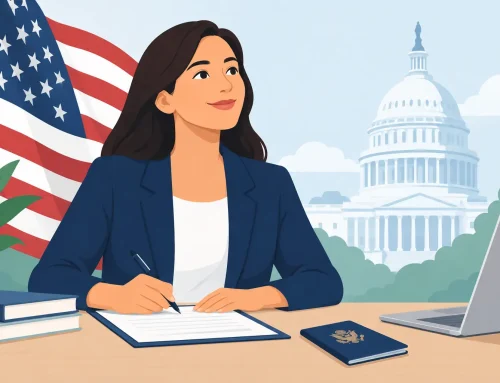


The citizenship interview can feel like one high-stakes appointment standing between you and a future you have worked years to build. A reliable US naturalization test study guide should do more than help you memorize facts. It should show you what the officer is evaluating, how the English and civics portions work, and when an exception may apply to your situation.
For many applicants, the test itself is manageable. The harder part is walking into the interview calm, prepared, and ready to answer questions about your application truthfully. Preparation gives you control over that moment.
Know What Happens at the Naturalization Interview
At the naturalization interview, a U.S. Citizenship and Immigration Services officer will review your Form N-400, Application for Naturalization. The officer may ask about your identity, travel outside the United States, marital history, children, work, taxes, criminal history, and any changes since you filed.
The officer is also evaluating whether you meet the English and civics requirements, unless you qualify for an exception or accommodation. The interview is not simply a quiz. Your answers must be consistent with your application and your immigration history.
If you do not understand a question, it is appropriate to ask the officer to repeat or rephrase it. Do not guess about facts on your application. A wrong answer about a civics question can usually be corrected by more study. An inaccurate answer about an arrest, travel, tax issue, or prior immigration filing can create a more serious problem.
The Three Parts of the Citizenship Test
Most applicants complete three testing components during the naturalization interview: civics, English speaking, and English reading and writing.
Civics: U.S. Government and History
Under the commonly administered civics test, the officer asks up to 10 questions from a list of 100 approved questions. You must answer six questions correctly to pass. The questions cover American government, the Constitution, geography, history, and civic responsibilities.
Some answers change over time. Questions about elected officials, for example, require the current answer for your location and the date of your interview. Study the underlying concept as well as the wording. If you know what a U.S. senator does, how many senators there are, and who represents your state, you are less likely to be thrown off by a question asked differently than you expected.
Focus on commonly confusing areas, including the branches of government, checks and balances, federal versus state powers, the reasons colonists came to America, major wars, and the rights protected by the Constitution. Learn names and dates where they are required, but do not let memorization replace understanding.
USCIS can revise testing procedures and materials. Before your interview, confirm the version of the test that applies to your application and use current official study materials.
English Speaking
The speaking portion is often less formal than applicants expect. The officer assesses your ability to understand and respond in English throughout the N-400 interview. This is one reason it helps to practice answers to the questions on your own application out loud.
You do not need perfect grammar or an accent-free voice. You need to show that you can understand ordinary questions and communicate your answers. Practice short, truthful responses such as your address, the dates of trips, your marital status, and whether you have filed your taxes.
English Reading and Writing
For reading, you will be asked to read one sentence in English correctly. For writing, you will write one sentence in English correctly. You have up to three chances to pass each section.
The sentences generally use vocabulary related to U.S. civics and history. Practice reading words such as “President,” “Congress,” “citizens,” “Washington,” “vote,” and “America.” For writing, work on clear spelling, capitalization, and basic punctuation. The goal is understandable writing, not a polished essay.
A Study Plan That Works When Life Is Busy
Many citizenship applicants are balancing work, children, caregiving, and the stress of an immigration process. Studying for hours at a time is not the only path to success. Consistent short sessions are usually more effective.
Start by reading all 100 civics questions once without trying to memorize every answer. Then separate questions into three groups: answers you know, answers you partly know, and answers you have never seen. Spend most of your time on the last two groups.
A practical weekly routine is to study 10 to 15 civics questions each day, review old questions before adding new ones, and practice a few reading and writing sentences. Say answers aloud. Have a family member ask questions in a different order. The officer will not ask them in the order printed on a study sheet, and your practice should reflect that.
Use flashcards if they help, but do not depend on flashcards alone. Explain an answer in your own words. For example, instead of only reciting that there are three branches of government, explain that they are legislative, executive, and judicial, and that each has different responsibilities. Understanding makes recall stronger under pressure.
In the final week before the interview, review your completed N-400 carefully. Bring your focus back to your own history. Know the dates and locations of trips, the names of spouses and children, your employment history, and any documents you submitted after filing. If something has changed, be prepared to explain it accurately.
When You May Not Need the Standard English Test
Some applicants qualify for an English-language exception based on age and time as a lawful permanent resident. The common rules are known as 50/20 and 55/15. An applicant who is age 50 or older and has been a lawful permanent resident for at least 20 years may qualify. An applicant who is age 55 or older and has been a lawful permanent resident for at least 15 years may also qualify.
Applicants who qualify under these rules may take the civics test in the language of their choice with an interpreter. They still need to pass the civics test.
There is also a special consideration for certain applicants age 65 or older who have held lawful permanent resident status for at least 20 years. These applicants may receive a simplified civics study list, but they should confirm the current requirements before relying on it.
A medical disability exception may be available when a physical or developmental disability or mental impairment prevents an applicant from meeting the English or civics requirements. This is not automatic. It generally requires Form N-648, completed by a qualified medical professional, with a detailed explanation of the condition and its effect on testing ability.
An exception request deserves careful attention. Incomplete forms, vague medical explanations, or conflicts with the N-400 can delay a case or lead to questions at the interview.
Do Not Treat the Test as Separate From Your Case
Passing six civics questions does not erase an eligibility concern. USCIS may still examine continuous residence, physical presence, good moral character, tax compliance, selective service registration when applicable, prior statements to immigration officials, and whether a marriage-based applicant is still eligible under the rule used to apply.
This is especially important if you have been arrested, traveled abroad for long periods, owe taxes, divorced after receiving a marriage-based green card, or previously received a denial. These circumstances do not always prevent naturalization, but they can change the strategy. Get clear legal advice before the interview rather than hoping a difficult issue will not be raised.
At Fletcher Law Office, citizenship cases are approached as more than paperwork. The goal is to identify the facts that may affect your approval, prepare you for the interview, and protect the progress you have made toward a secure future in the United States.
The Day Before and the Day of Your Interview
The day before, put your interview notice, green card, state identification, passport, and any requested original documents in one place. Review your N-400 one more time, but avoid last-minute cramming that leaves you exhausted. Get rest and plan to arrive early.
At the interview, listen carefully and answer only the question asked. Be honest, respectful, and direct. If you need the officer to repeat a question, ask. If you made an error on your application or have a change to report, do not hide it. Bring supporting documents when appropriate and explain the facts clearly.
Citizenship is a meaningful achievement, and preparation is one way to honor the work that brought you here. Study steadily, understand your own case, and seek guidance early if any part of your immigration history makes you uncertain.